Boxing training system for blind or visually impaired people
Aline Zimmermann, Bianca Trăistar, Eugenia Mazanik, John Cowhie & Nicklas Heublein
Malmö University, 2022
Mitts & beats aims to help hobbyist boxers who are blind or have low vision to participate in gym training sessions. The interactive system provides a beat to be matched by the boxer and gives audio feedback. Users progress through levels, experiencing coordinated and rhythmic training sessions.
Challenge
For the introductory course in Interaction Design, we had to develop an idea under the theme “Coordinated Movements & Human Proximity”. We chose to work with boxing and how to make the practice more inclusive. Generally considered quite a visual sport, it was interesting to explore what other aspects characterised the practice of gym boxing.
What we did
Observing and participating in gym boxing sessions, and interviewing participants, we delved into this world and picked apart reasons why people participate and what makes the practice unique and enticing. These reasons involve social, mental and physical aspects, all of which we took into account when designing our concept.
We also consulted with inclusive boxing gyms and interviewed visually impaired people who practice boxing. Our goal was to have them participate actively in developing the system with us, but time and logistical constraints made this impossible. For this first prototype, we held workshops and tested with sighted people with their eyes covered.


How it works
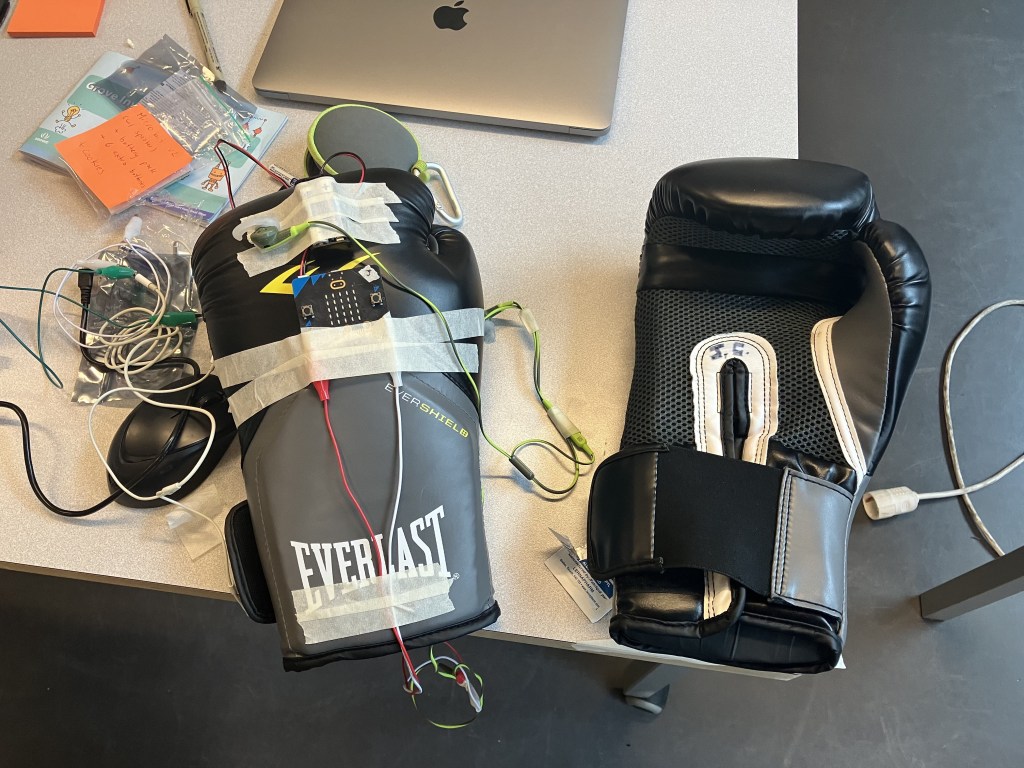
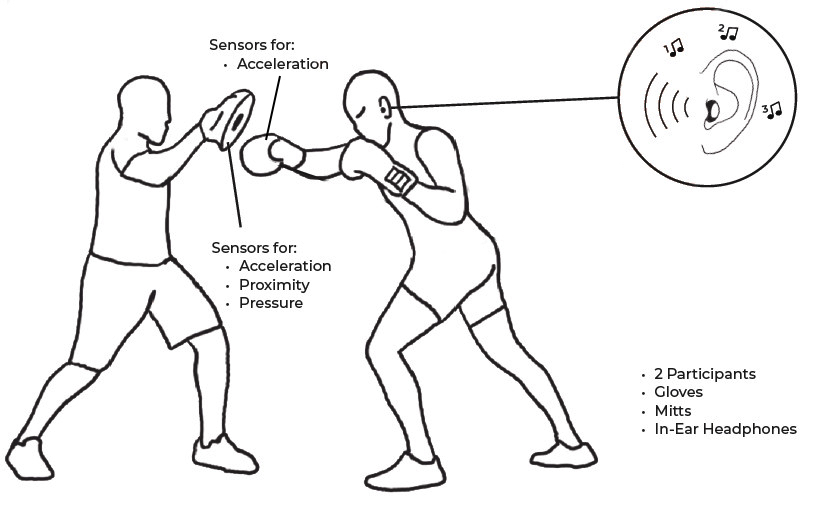
The set-up is comprised of three parts: boxing gloves for the user, mittens for the coach and earbuds for both. The gloves and mittens are equipped with accelerometers, distance and pressure sensors. Rhythm and repetition are a big part of boxing training, and the idea of progression was included with the different levels of increasing complexity, such as combinations of punches and speed. The user receives audio feedback on the rhythm, precision and force of punches and the spatial location of the mittens.
The system acts as a third agent in the boxer-coach relationship, enhancing the dynamism and rhythmic experience. It also transforms visual signals, such as the location of the mittens, into auditory ones, helping people with low vision participate in boxing training sessions.
 Aline Zimmermann Maya Simões